Lesson 3: Fractions and Scientific Notation
In this lesson, you will practice talking about different types of fractions and learn how to use decimal fractions for scientific notation. As promised, you will need to use ordinal numbers a lot.
Key vocabulary:
дробь – fraction
числитель – numerator
знаменатель – denominator
over = divided by
десятичная дробь – decimal fraction
точка в десятичной дроби – decimal point
экспоненциальная форма записи числа - scientific notation
основание степени – base
1/2 , 1/3 , 1/4 , ..., 1/10 | one half, one third, one fourth OR one quarter, ... , one tenth |
5/2 , 2/3 , 3/4 , ..., 7/10 | five halves, two thirds, three fourths OR three quarters,... , seven tenths |
3 548 | three over five hundred forty eight |
Decimal fractions / Decimals
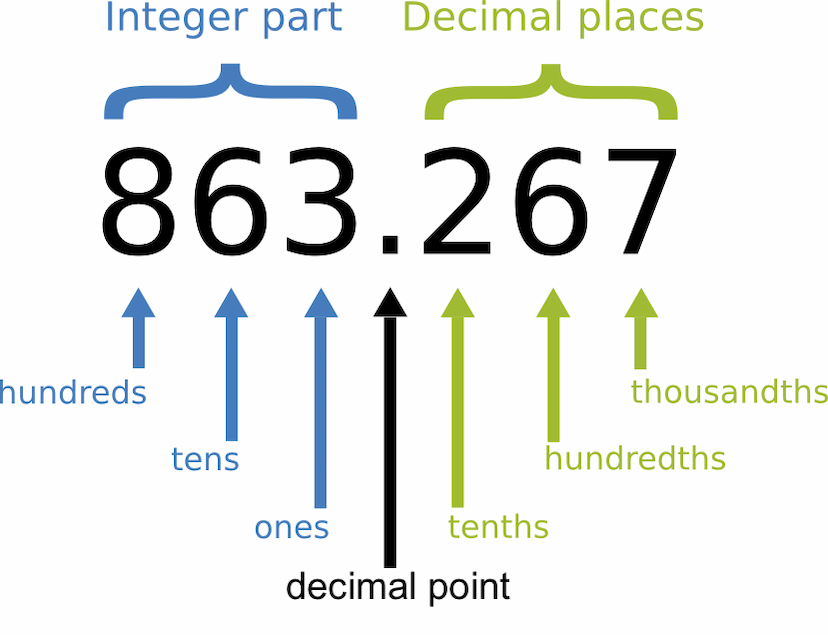
English speakers use a decimal point (.) and not a comma (,) in decimal fractions.
Look at the names of decimal places after the decimal point:
Десятые | tenths |
Сотые | hundredths |
Тысячные | thousandths |
Десятитысячные | ten-thousandths |
Стотысячные | hundred-thousandths |
Миллионные | millionths |
For example, 46.932468 is forty-six and nine hundred thirty-two thousand four hundred sixty-eight millionths. Wow…
Fortunately, there is also an easier way: forty-six point nine three two four six eight.
Let’s practice both ways to say decimals in Exercise 2:
Exercise 2
Read each decimal out loud in two ways (for example, 1.3 will be one point three AND one and three tenths). Then, listen to the audio to check your answer. Click ‘Translation’ if you want to look at decimals written out in words.
0.5 (or .5)
1.42
2.038
55.0146
3.14159
.002135
Scientific notation (Powers of 10)
Scientific notation is a method of writing large or small numbers in a shorter form. It is used in fields such as engineering, chemistry, microbiology, physics, and astronomy where very large and very small numbers are common.
Scientific notation simplifies calculations and represents precise measurements, such as 6.02214 × 10²³ for Avogadro’s number or 1.602176634 × 10⁻¹⁹ for the charge of an electron.
The basic formula used to write numbers in scientific notation is m ⨉ 10n where:
- m is a number greater than or equal to 1 but less than 10
- 10 is the base number
- n is the exponent, or power of ten, which is a positive or negative whole number.
For example, 4,800,000,000,000 is written in scientific notation as 4.8 ⨉ 1012 (‘4 point 8 times 10 to the power of 12’).
Similarly, 0.0000000000048 is written as 4.8 ⨉ 10−12. (‘4 point 8 times 10 to the power of negative 12’).